What is involved in this test? ANS: We sample a tiny amount of tears from your eye, that takes 2-4 seconds to get a reading.
Why is test important? ANS: Experts consider this the hallmark for dry eye diagnosis. It also allows us to grade severity and guide our treatment plan.
Is this test only done once? ANS: Since it allows us to see if any treatment is working for you, it may be done periodically throughout your treatments to monitor progress.
What does it do? ANS: The score tells us how salty the tears are, in comparison to normal.
What is normal? ANS: Scores <300 are normal.
Why is the “inter-eye difference” included in the scoring? ANS: If there is a different score between the eyes, then this may indicate a problem in the eye with the higher score during specific times, for example on a computer for long periods.
Wouldn’t I feel it if there is a problem? ANS: Sometimes people have NO symptoms especially later on in the disease process. WHY? The eye has gone numb and is called “hypaesthesia”. Even if you aren’t complaining, the disease can progress.
Click to Enlarge
Click to Enlarge
Click to Enlarge
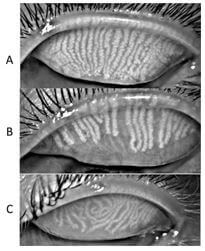
8 . How do they know the disease is progressing? ANS: There are now new ways to image the meibomian glands in the eyelids. We can see normal glands, top A in the image to the left. In B the glands have started to degenerate and some have scared and are now permanently dead, or in C they may be distorted.
This test, called meibography, is now available at some of the large specialty offices in Toronto.
If you are suffering from dry eyes, take the Dry Eye questionnaire “#03 Ocular Surface Disease Index (Dry Eye) Assessment” . We can assess your score from the questionnaire and contact you to schedule an appointment.
What is involved in this test? ANS: It takes about 1 minute to collect some tears. The results are ready in 10-15 minutes.
Why is test important? ANS: Experts consider this the biomarker for more severe inflammatory dry eye. It also allows us to grade severity then treatment more or less intensively. If positive, anti inflammatories will need to be prescribed.
Is this test only done once? ANS: Since it allows us to see if any treatment is working for you, it may be done periodically throughout your treatments to monitor progress. If you are having a flare up, it may be done before restarting steroid therapy.
What does it do? ANS: The score tells us if there is an inflammation marker called MMP-9 in your tears.
What is normal? ANS: Its kinda like a pregnancy test, its positive or its not.
What can be done if the test is positive? ANS: Traditionally, a steroid will be prescribed on a tapering dose for a short period of time.
What happens if you need treatment for longer since I am still having irritation? ANS: Depending on the severity and cause, you may be given long term anti inflammatories called Restasis, or Xiidra. Usually, you will be prescribed 2 medications to be taken together.
What if I am scared of taking a steroid. I’ve heard there can be side effects? ANS: If the test is positive, you will likely continue to have irritation until it is treated with anti inflammatories. While on a steroid, you will be monitored carefully for cataracts and IOP (Eye Pressure).
Click to Enlarge
3. Tear Volume Testing
Question and Answer...
1 . Why is this test important? ANS: Tear volume tests are important to determine if you produce enough tears to keep your eyes moist and healthy.
2. Doesn’t everyone produce tears? ANS: No. Even being dehydrated can result in less tear production. However, an autoimmune disease, called Sjogren’s disease, causes dry eyes and dry mouth as the primary symptoms. It may have effects on multiple organs and is a risk factor for non Hodgkin’s lymphoma. Early diagnosis and treatment is key to helping these patients.
Two tests can be used to measure tear production...
1. Shirmer's Strip Test.
a . What is involved in these tests? ANS: We insert a strip in your eyelid to collect tears. The Shirmer’s strip is inserted in your lid for 5 minutes.
b. What is normal for Schirmer’s readings? ANS:
Normal levels: if >10 mm strip wetting Low levels: if < 5 mm strip wetting
2. SM Tube Test - The New Test.
a . What is normal for SM Tube readings? ANS: SM tube takes 5 seconds to collect tears, and is the newer test for tear volume. Normal levels: >5 is normal Low Levels: < 5 is deficient
b . What can be done if the test is low? ANS: Environmental changes, lifestyle changes, water intake, nutraceuticals, lid hygiene, and prescription medications may help.
c. What if I am scared of taking a steroid. I’ve heard there can be side effects? ANS: If the test is positive, you will likely continue to have irritation until it is treated with a steroid for a few days. While on a steroid, you will be monitored carefully for cataracts, and IOP(Eye Pressure).
d. What happens if you need treatment for longer since I am still having irritation? ANS: Depending on the severity and cause, you may be given drops called Restasis, or Xiidra in addition to a steroid in the eye. The steroid will be stopped allowing time for the 2nd anti inflammatory to start working and continued long term. Sjogren’s patients will be prescribed oral medications, as well.
Click to Enlarge
Click to Enlarge
We need your feedback to help us improve our website. Click HEREfor a 1 minute anonymous survey. Thank You! 🙂